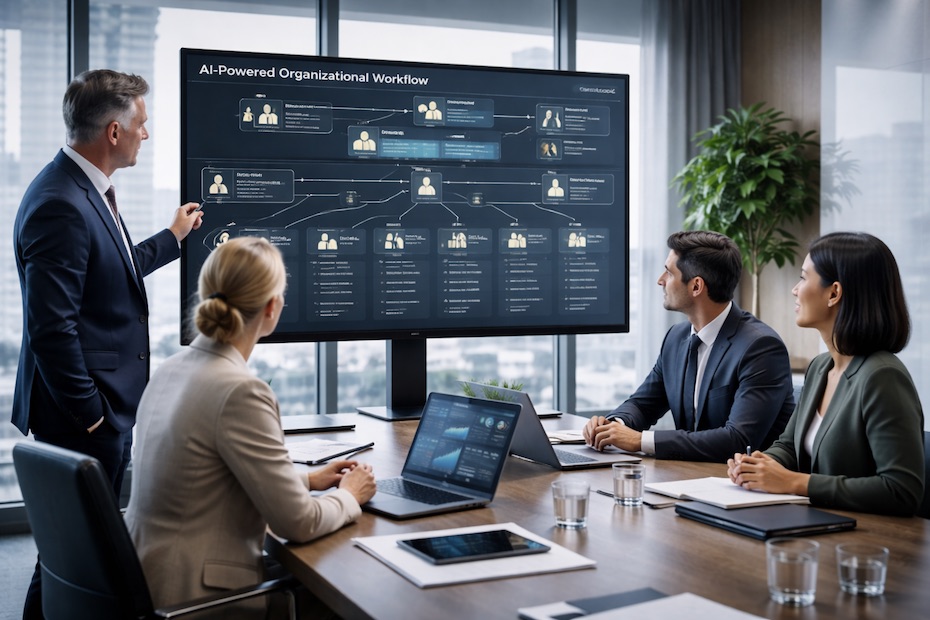
AI agents are reducing the need for traditional middle management by automating coordination, reporting, and execution oversight that once required human supervision. Organizations adopting agent-driven workflows are shifting toward flatter structures where work moves through systems, not managerial layers.
This article explains how AI agents are changing organizational design, which middle management functions are disappearing or changing, and how you can restructure teams without losing accountability or leadership strength. You will see what is changing now, what remains human-led, and how to guide the transition with clarity.
Are AI agents replacing middle managers?
AI agents are replacing functions, not people, by taking over routine planning, monitoring, and task coordination traditionally handled by middle managers. These systems assign work, track performance, and surface issues without daily human intervention.
In many organizations, middle managers spent most of their time relaying information upward, distributing tasks downward, and compiling status updates. AI agents now perform these activities continuously and with greater consistency. This reduces the operational need for entire management layers built around supervision rather than decision authority.
Hiring data from 2024–2025 shows fewer postings for traditional supervisory roles and increased demand for senior individual contributors and AI-literate leaders. This shift signals structural change rather than temporary experimentation.
What exactly do middle managers do that AI agents now handle?
Middle managers historically coordinated schedules, tracked output, enforced process compliance, and reported performance. AI agents now execute these activities faster and with fewer errors.
Modern workflow agents route tasks automatically based on priority, availability, and skill. Performance monitoring agents flag deviations in real time instead of waiting for weekly reviews. Reporting agents generate live summaries without manual compilation.
When these responsibilities move to systems, the managerial role built around oversight loses relevance. The remaining value lies in judgment, people leadership, and decision authority.
How are organizational structures changing as AI agents scale?
Organizations are moving away from pyramid structures toward flatter, execution-focused designs. Work flows horizontally through systems rather than vertically through reporting chains.
Instead of asking who approves each step, AI agents manage execution inside predefined boundaries. Human leaders intervene only when exceptions, trade-offs, or people-related issues arise.
This shift replaces rigid org charts with fluid work allocation models. Authority becomes clearer, while bureaucracy shrinks.
Does this mean middle management is disappearing entirely?
Middle management is shrinking, not vanishing. Roles centered on supervision and reporting are declining, while roles focused on coaching, interpretation, and coordination across humans and AI are expanding.
Organizations still need leaders close to the work who can resolve conflict, guide development, and interpret complex signals. AI does not replace these responsibilities.
What disappears is the layer whose primary purpose was information transfer. What remains is leadership grounded in judgment and human capability.
Which industries are seeing the biggest impact first?
Industries with high process density and digital workflows are experiencing the fastest structural changes. Technology, finance, logistics, customer support, and large professional services firms lead adoption.
In these environments, AI agents already manage ticket routing, compliance tracking, forecasting, and resource allocation. Middle managers overseeing these workflows are no longer required at previous scale.
Industries with heavy physical operations or regulatory complexity are changing more slowly, though agent adoption continues to expand.
How do AI agents change accountability inside organizations?
Accountability becomes more explicit when AI agents manage execution. Decisions, actions, and outcomes are logged automatically, reducing ambiguity.
Instead of accountability diffusing across layers, ownership becomes visible. Leaders define outcomes. AI executes within limits. Humans intervene when thresholds are crossed.
This clarity strengthens governance and reduces the risk of blame shifting that often occurred in complex hierarchies.
What new leadership roles are emerging as middle layers shrink?
New roles focus on system ownership, performance interpretation, and human development. These leaders supervise AI systems rather than teams of coordinators.
Titles vary, but responsibilities converge around outcome accountability, talent development, and cross-functional alignment. These leaders ensure AI execution matches business intent.
This represents an elevation of leadership rather than a reduction. Authority increases as execution noise decreases.
How should executives redesign teams during this transition?
Redesign starts with mapping work, not people. Identify which tasks require judgment and which follow rules. Automate the latter. Elevate the former.
Teams become smaller but more capable. Individuals gain autonomy supported by AI agents that manage coordination. Managers shift from supervision to enablement.
Clear communication matters. People need to understand how roles change, where authority sits, and how career paths evolve in flatter structures.
What risks come with removing management layers too quickly?
Removing layers without redesign creates gaps. AI agents require clear boundaries, escalation rules, and ownership. Without these, execution stalls or errors compound.
Cultural resistance also matters. Employees may fear loss of support or unclear advancement. Leaders must invest in reskilling and role clarity.
Successful organizations move deliberately. They replace supervision with systems and leadership with intent, not cost cutting alone.
How does this shift affect career progression?
Career progression becomes skill-based rather than title-based. Advancement depends on impact, decision quality, and system leadership.
High performers gain visibility through results rather than position. Leadership paths widen to include technical, strategic, and people-focused tracks.
This model rewards capability and adaptability, aligning career growth with modern organizational needs.
Is middle management ending because of AI?
- AI agents handle coordination, monitoring, and reporting
- Organizations flatten around workflow systems
- Middle management roles shift toward coaching and judgment
- Leadership remains human-led
Lead the Structural Shift With Intent
AI agents are changing how organizations operate, not removing the need for leadership. When routine oversight moves to systems, human leaders gain space to focus on judgment, development, and direction. You can use this shift to simplify structure, strengthen accountability, and elevate meaningful work. The organizations that succeed redesign roles deliberately rather than reacting defensively. Middle management does not disappear; it evolves into leadership that machines cannot replace.
If you want to explore more executive-level thinking on organizational design, leadership evolution, and AI-driven change, visit my weebly and read my latest posts.

Jay Holstine is a Vistage Chair and veteran tech CEO with 20+ years of experience in SaaS and operations. The founder of SigmaFlow and former CEO of Freightflow, he now leads a Dallas–Fort Worth CEO peer group and advises executives on strategy, process improvement, and scalable growth.