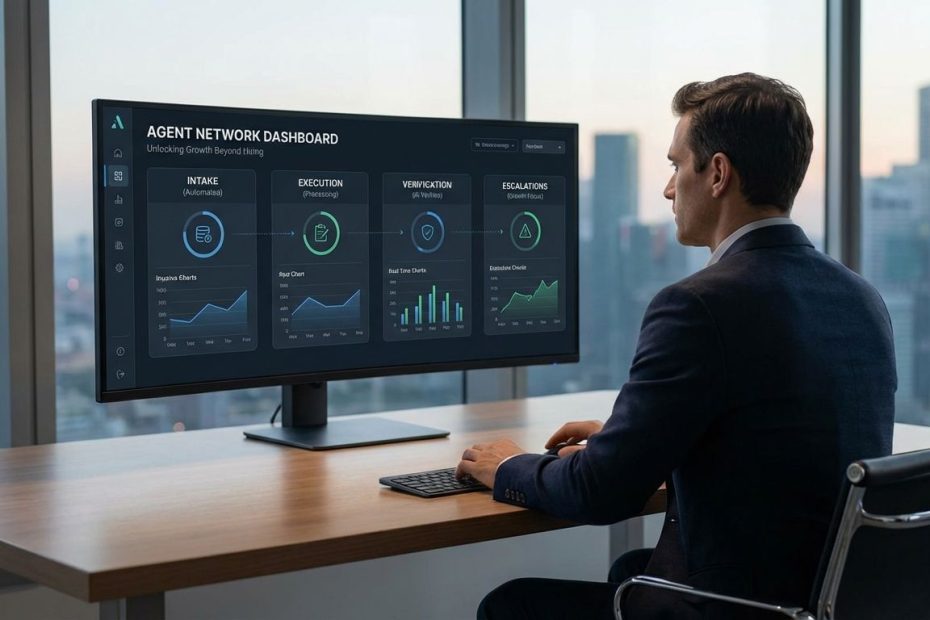
If growth feels capped by headcount, agent networks remove the cap by turning slow, human-queued work into an always-on system that classifies, executes, verifies, and escalates across your tools. You stop waiting on recruiting cycles and start shipping output continuously, with humans focused on exceptions and decisions.
This guide shows how to spot the bottlenecks that actually limit revenue, design an agent network that behaves like a reliable production workflow, and measure ROI against hiring without getting trapped in hype. You’ll leave with a practical architecture, rollout sequence, and risk controls that executives accept and operators can run.
How Do Agent Networks Actually Remove Growth Bottlenecks Better Than Hiring?
Most “growth bottlenecks” are not strategic failures, they are queue failures. Leads wait too long for a first touch, trial users sit without onboarding help, inbound tickets stack up, renewal risks go unseen, ops requests pile into a shared inbox, and reporting arrives after decisions already got made. Hiring addresses queues, but it does so with long lead time: sourcing, interviews, onboarding, access provisioning, training, calibration, quality control. By the time the role becomes productive, the queue has already shifted.
An agent network attacks the queue directly. Instead of assigning work to one person at a time, you decompose the workflow into roles that run in parallel: intake, enrichment, execution, verification, and escalation. That structure matters because bottlenecks usually hide inside handoffs, not inside a single task. A lead that needs enrichment plus personalization plus CRM updates plus follow-up timing will stall when those steps sit across people, calendars, and priorities. A network runs those steps as one linked chain, and when something breaks it routes the exception with a complete packet of context so a human resolves it fast.
Operationally, an agent network behaves less like “one smart assistant” and more like a production line with controls. One agent triages, another performs tool actions, a verifier checks policy or data consistency, and a supervisor applies limits. You get predictable throughput because work no longer waits for availability, and you gain consistency because the same decision rules apply every time. That is how the network replaces the bottleneck: it reduces waiting, reduces rework, and reduces the number of touches required per outcome.
This is also why agent networks beat hiring on a specific axis: elasticity. When volume spikes, a newly hired team cannot instantly expand. A network scales by adding capacity and parallelism inside the workflow, not by expanding org charts. The win is not “fewer people,” the win is “more output per constrained hour,” with constrained hours reserved for judgment, relationship management, and final approvals.
What’s The Difference Between “AI Agents,” “Agentic AI,” And Automation/RPA (And How Do You Avoid Agent-Washing)?
The easiest way to get burned in this category is to buy labels instead of capabilities. Automation and RPA execute scripted rules with deterministic steps, they work great when the environment is stable and inputs are well-structured. Assistants generate content or answer questions, they can be valuable but they rarely own an outcome because they do not take tool actions with accountability. Agents plan and take actions across tools, then adapt when an action fails, a permission is missing, or information conflicts.
“Agentic AI” usually refers to the design pattern more than the product category: goal-directed behavior, tool use, multi-step planning, memory, and feedback loops. In practice, what matters for your business is not the name, it is whether the system can reliably move work from intake to completion with auditable steps. Many products get rebranded as “agents” when they are still prompt-and-response interfaces. That creates the classic mismatch: leadership expects autonomous workflow ownership, the product delivers drafted text that still requires humans to copy, paste, and babysit.
A tight anti-washing test keeps procurement honest. The system needs 1. real tool execution, not just suggestions, 2. recovery behavior when a step fails, 3. cross-tool coordination, and 4. logs that show what happened and why. Add a fifth: the ability to operate under explicit limits, including approvals for sensitive actions. If a vendor cannot demonstrate these under your data and your tools, it is not an agent network, it is an assistant wrapped in marketing.
There is another practical distinction that matters at scale: ownership of failure cases. RPA breaks loudly and predictably, it throws an error when a selector changes or a field is missing. Agents can fail quietly: an incorrect assumption, a misread record, a fabricated detail, a misplaced update. That shifts your evaluation from “does it run” to “does it run with controls that prevent silent damage.” That is where many teams lose ROI and why disciplined definitions matter before rollout.
Which Workflows Are People Successfully Replacing With Agents Today (And Which Ones Still Need Humans)?
Agents replace the most value when the workflow is high-volume, repeatable, and bounded by clear decision rules. In real operator conversations, the most common wins show up in customer support triage, order or status lookups, lead enrichment and qualification, outbound personalization at scale, content operations with editorial oversight, and internal service desks that route requests with summaries. The consistent pattern is not “human removed,” it is “human relocated” from repetitive handling to QA and exception resolution.
Teams also report replacement success when the workflow was already structured, meaning inputs were known, outputs were standardized, and the failure states were documented. That is why ticket triage and routing often go first. The agent can read a request, classify it, pull relevant account context, fetch knowledge base snippets, propose a response, then either send under a confidence threshold or route to the right owner with the research complete. That removes the “first mile” delay that customers feel and operators hate.
Where humans still remain essential is where the cost of a wrong action is high, the judgment criteria are ambiguous, or the organization cannot define safe boundaries. Refund approvals, contract exceptions, pricing changes, policy decisions, sensitive account changes, production deployments, security rule modifications, and commitments that change customer expectations still demand human sign-off. Not because agents cannot draft, but because accountability sits with the business. A mature setup treats these as controlled escalations, not as areas to prove autonomy.
One more filter helps avoid disappointment: environment volatility. If the workflow depends on brittle web interactions, inconsistent third-party UIs, shifting schemas, or unpredictable data quality, the agent’s “intelligence” will not rescue it. Reliability comes from stabilizing the execution layer, tightening integrations, adding retries, and building monitoring. When operators talk about agents “replacing” work, they often mean the workflow became infrastructure: defined, observable, and maintained, not a string of clever prompts.
How Do You Measure ROI Vs Hiring, What Metrics Should You Use?
ROI measurement fails when it anchors on headcount. The business value rarely comes from eliminating a role outright, it comes from removing delay, lifting throughput, and reducing cost-to-serve. Hiring adds capacity linearly and slowly. An agent network improves unit economics when it shrinks cycle time, reduces touches per outcome, and prevents rework. That is what leadership will fund again, because it shows up in revenue capture and margin.
Use metrics that map to your bottleneck, not generic “hours saved.” In go-to-market, track lead response time, contact-to-meeting conversion, meeting show rate, pipeline created per rep, and time spent on research versus conversations. In support, track time-to-first-action, time-to-resolution, deflection rate, escalation rate, and repeat-contact rate. In operations, track request aging, backlog size, error rates, and audit findings. Pair each throughput metric with a quality metric so the network cannot “win” by dumping mistakes on humans downstream.
Cost-to-serve is the executive-friendly layer. Measure cost per qualified lead, cost per resolved ticket, cost per onboarded customer, and cost per renewed account. Tie costs to tool calls, human review time, and exception handling. That structure lets you compare “agent network + reviewer” to “new hire + manager + enablement,” using the same language of capacity and performance. It also makes it harder to hide failure: if exceptions spike, cost-to-serve spikes, and the model tells the truth quickly.
Keep one more metric on the dashboard: automation yield. Define it as the percentage of cases completed without human intervention, plus the percentage completed with only lightweight approval. That distinction matters because the network can deliver huge value even when it still requires sign-off at the end. Yield is the number that climbs as you tighten boundaries, improve retrieval, and reduce false escalations.
What Are The Biggest Risks (Hallucinations, Security, Compliance, Liability) When You Let Agents Run Workflows?
The operational risks show up in three buckets: unreliable outputs, unsafe actions, and unclear accountability. Unreliable outputs include wrong facts, stale data, incorrect assumptions about customer context, and inconsistent application of policy. Unsafe actions include sending the wrong message to the wrong person, updating the wrong record, triggering an unintended workflow, or taking steps that expand access beyond intent. Unclear accountability appears when multiple agents touch a chain and nobody can answer who approved what, under what rule, with what evidence.
Hallucinations are not only a “chat” problem, they become a workflow problem when an agent fills gaps with invented details, then acts on them. The fix is not motivational prompting, it is engineering: retrieval with citations to your internal sources, strict input validation, confidence scoring, and verification loops that compare outputs against trusted data. A verifier agent can catch obvious inconsistencies, but the real control comes from limiting actions to what can be validated and logged.
Security risk shifts when agents can use tools. Traditional access control assumes a human user with a stable role. Agents operate across systems and can chain actions in ways your policies did not anticipate. That demands intent-based controls: allowlists of actions, scoped tokens, just-in-time permissions, and action-level logging. A strong pattern is “least privilege per workflow,” where the network gets the minimum permissions required to complete that workflow, and nothing else.
Liability risk rises when the agent’s outputs become real-world commitments. A mistaken refund, an incorrect cancellation, a misrouted escalation, a wrong status update, these are not abstract model errors, they are business errors. That is why governance cannot be vague. You need a clear owner for each workflow, a clear approval policy, and a clear audit trail. When something goes wrong, root cause analysis should be possible without a debate about whether the vendor, the prompt, the integrator, or the user “caused” it.
If You Want An “Agent Network,” What’s The Minimum Viable Architecture (And What Should You Implement First)?
The minimum viable architecture is role-based and observable. You need an intake agent that classifies and prioritizes, one or more worker agents that take tool actions, a verifier that checks outputs against rules and data, plus escalation routing and approvals. Without verification and escalation, you do not have a network, you have a liability generator. Without logging, you do not have operations, you have guesswork.
Start with one workflow that has strong signal, clear boundaries, and measurable pain. Good starters include inbound support triage, lead enrichment and routing, internal IT/service desk triage, order status responses, and report generation where the output format is standardized. Attach the workflow to a single owner and define what “done” means in system terms: updated fields, sent messages, ticket tags, created tasks, posted summaries. Then lock down permissions so the network cannot drift into actions you did not approve.
Implementation sequencing matters more than model selection. Build the data path first: event ingestion, retrieval from trusted sources, and tool APIs. Add monitoring next: run logs, action logs, error logs, and human feedback capture. Add guardrails next: thresholds, allowlists, deny rules, and approval gates. Only after those exist should you push for higher autonomy. Autonomy without operations turns into silent failures that surface when customers complain or finance reconciles.
The fastest route to stable value is a “generate, verify, act” loop. The worker drafts an action plan and proposed outputs, the verifier checks for policy, correctness, and completeness, then the worker executes tool actions under explicit constraints. Humans approve only where the risk profile demands it. Over time, as the verifier proves reliable and exception patterns are documented, approvals can narrow and yield climbs.
What Is An Agent Network In A Business Workflow?
- Always-on agents that: intake → plan → act across tools → verify → escalate
- Built for throughput, guardrails, logs, and predictable handoffs
Make Your Bottleneck The Product, Not The Org Chart
Your growth bottleneck will not disappear because another role gets added, it disappears when the workflow becomes a reliable system with clear inputs, clear outputs, and controlled failure states. Agent networks deliver that when you treat them like operations: define the workflow, wire the tools, set guardrails, measure yield, and keep humans focused on exceptions and decisions. Start with one queue that visibly limits revenue or retention, then prove cycle time reduction and quality stability before expanding. Keep autonomy tied to risk, keep permissions tight, keep logs complete, and keep ownership explicit. When that discipline is in place, the network stops being a demo and starts being capacity you can count on.
References
- Reddit: Which AI agent replaced actually replaced a human workflow?
- BCG: Agentic AI Blurs Line Between Tool and Teammate
- Gartner: Over 40% of Agentic AI Projects Will Be Canceled by End of 2027
- Gartner: 40% of Enterprise Apps Will Feature Task-Specific AI Agents by 2026
- WIRED: Who’s to Blame When AI Agents Screw Up?
- IT Pro: 84% of Developers Are Using AI, Nearly Half Don’t Trust Accuracy
- TechRadar: AI Agents Are About to Make Access Control Obsolete
- arXiv: Hallucination Mitigation using Agentic AI Natural Language-Based Frameworks

Jay Holstine is a Vistage Chair and veteran tech CEO with 20+ years of experience in SaaS and operations. The founder of SigmaFlow and former CEO of Freightflow, he now leads a Dallas–Fort Worth CEO peer group and advises executives on strategy, process improvement, and scalable growth.