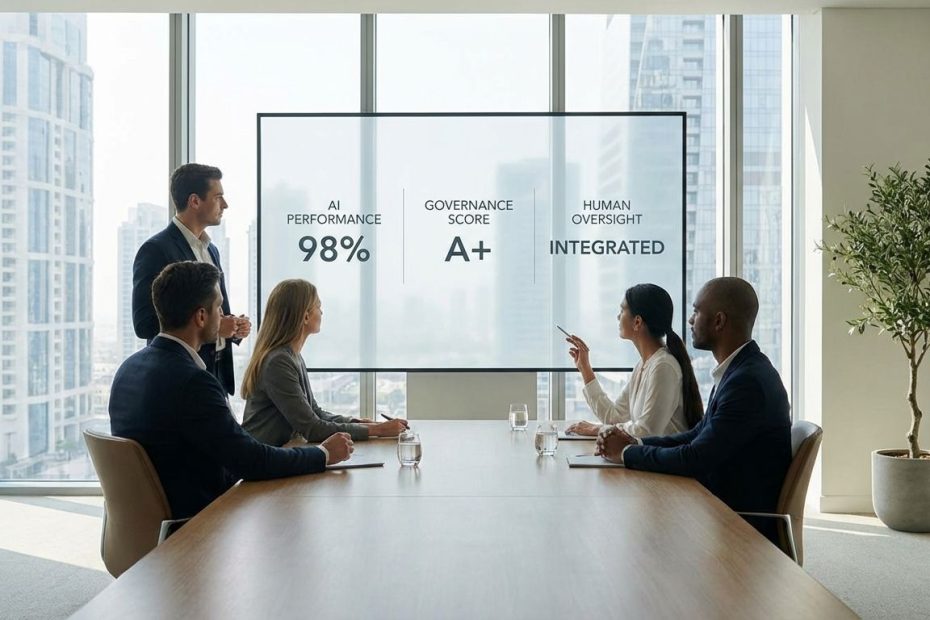
You balance tech and humanity in the AI era by running AI like a business-critical system, with clear decision rights, measurable human outcomes, and disciplined risk controls that do not slow delivery. The goal is simple: ship useful automation without breaking trust, degrading accountability, or turning your workforce into passive operators.
This article gives you a leader’s operating playbook for AI adoption that holds up under real scrutiny from employees, customers, regulators, and auditors. You will leave with practical lines you can draw for people-related decisions, a governance setup that scales beyond pilot projects, and execution habits that keep speed, safety, and morale moving in the same direction.
How Do Leaders Balance AI Efficiency With Human Empathy And Trust?
Balance starts with what you measure. If the scoreboard only shows cycle time, headcount saved, tickets closed, and cost per transaction, teams will optimize for automation even when it harms customers or employees. You need a dual scoreboard: productivity metrics alongside trust metrics, fairness checks, and user experience signals that are reviewed with the same seriousness as revenue or uptime.
Trust is not “culture work” that sits off to the side. It is an operating constraint that affects adoption, accuracy, incident load, attrition, and brand risk. When you treat trust as a deliverable, you can manage it: define acceptable error rates by use case, require explanations in plain language for AI-supported decisions, and enforce appeal paths when AI influences outcomes.
Empathy in AI leadership is not about saying comforting things. It is about designing processes that respect people’s time, agency, and dignity. That means building workflows where humans stay in control at key moments, and where employees can challenge tool outputs without being labeled “anti-innovation.” If the tools cannot be questioned, the organization is not running AI, the AI is running the organization.
Practical moves that land well in real companies are boring on purpose. You create “human-owned moments” in workflows that affect careers, pay, access, safety, and customer vulnerability. You publish decision tiers, you train managers to review AI output without rubber-stamping, and you make it normal to say, “The model might be wrong, show the evidence.”
One point matters more than the rest: you cannot delegate accountability to the data science team. Senior leadership owns the risk posture, the incentives, and the policy boundaries. If accountability is fuzzy, AI will become a shadow operations layer where nobody can explain why outcomes happen.
What Should Leaders Do When Employees Fear AI Will Replace Their Jobs?
Address job fear with specifics, not reassurance. Employees hear “AI will augment you” as a slogan unless you pair it with a role-by-role plan and a timeline. You earn credibility by stating what work will be automated, what work will expand, what new responsibilities will appear, and what support the business will fund.
Start with an impact map that is written in business language, not model language. Break roles into task groups, label each group as automate, assist, redesign, or keep human-only, then publish the assumptions. You do not need perfect accuracy, you need a visible baseline that people can critique. That critique is a gift, it will expose edge cases and hidden work that your leadership team is not seeing.
Commit resources that match the disruption. Training is not an internal wiki page and a lunch-and-learn. Put time on calendars, provide access to tooling, and make managers accountable for skill progression. If performance targets stay the same while workload rises because employees are asked to “learn AI on their own time,” the rollout will fail through quiet resistance and rising turnover.
Rebuild trust by removing surprise. Announce principles for workforce changes, define how redeployments work, set rules for how AI is used in performance evaluation, and document what will never be fully automated. If people believe AI is a pretext for cuts, they will treat every tool as surveillance and every metric as manipulation, even when the intent is productivity.
Also manage the information environment your workforce lives in. Many employees already distrust AI answers in consumer products, and that distrust spills into internal rollouts. When external search experiences feel more AI-saturated, skepticism increases and leaders must compensate with more transparency, stronger evaluation discipline, and faster correction loops.
Where Should You Draw The Line On Using AI For Decisions About People?
Draw the line based on stakes and reversibility. When a decision affects someone’s employment, income, promotion path, access to services, or legal rights, AI should not be the decision-maker. AI can contribute evidence, pattern detection, and consistency checks, yet a trained human must own the final decision and be able to explain it.
Use decision tiers that your organization can actually enforce. Low-stakes work can be automated with monitoring, medium-stakes work can run on AI recommendations with approval, and high-stakes work requires human decision ownership with documented reasoning and an appeal path. This is not bureaucracy for its own sake. It is how you keep the organization defensible when outcomes are questioned.
Set rules for what counts as “high-stakes” inside your business. Hiring, firing, performance ratings, promotions, disciplinary actions, compensation changes, access control, fraud flags that block customers, and safety-related decisions belong in the highest tier. If your team pushes back that “it will slow us down,” the answer is that speed is not the only requirement when human impact is real and the cost of a bad decision is long-lasting.
Operationalize the line with workflow design. Require that the reviewer sees the same inputs the model saw, can override without penalty, and must record a short rationale. Make the appeal process real, not symbolic: define a channel, a response time, a reviewer role, and a way to remediate the model or process when patterns emerge.
Do not hide behind “human in the loop” language if the human is only clicking approve. You want “human in control,” with training, authority, and accountability. If managers are overloaded, they will rubber-stamp model output. That is a resourcing issue, not an ethics issue, and it belongs on your leadership agenda.
What Policies And Governance Do You Need So AI Is Used Responsibly?
Governance that works in practice has four visible pieces: an AI use policy, an inventory of AI systems and deployments, a risk review process tied to business approval, and executive accountability that cannot be bypassed. If any of those is missing, teams will still ship AI, just without shared rules, and the organization will learn about risk through incidents.
Start with a policy that is written for operators, not lawyers. Cover acceptable data sources, handling of personal data, restrictions on confidential information, rules for customer-facing generation, documentation requirements, and approval triggers. Include a short list of prohibited uses that employees can remember. Tie the policy to a tool experience, like a mandatory acknowledgement inside the internal AI interface.
Build and maintain an inventory that answers basic questions: what models are used, what data feeds them, what systems they touch, who owns them, where outputs go, and what controls exist. Without an inventory, you cannot govern. You cannot respond to incidents quickly, you cannot comply with audits, and you cannot prioritize fixes based on where risk clusters.
Make risk review a business workflow, not a moral debate. Define intake, assign reviewers, require a risk classification, record mitigations, and set monitoring obligations. Keep the process fast by standardizing templates and test requirements by tier. The goal is predictable delivery with predictable controls, not permission theater.
Anchor your program to established standards when your organization needs repeatability. Many leaders use NIST’s AI Risk Management Framework as a risk language and operating model, and ISO/IEC 42001 when they want a management system structure that supports audits and continuous improvement. The point is not compliance theater. The point is clarity: who decides, how decisions are documented, how performance is monitored, and how you improve over time.
Put a single accountable executive on the hook for AI governance outcomes, with a cross-functional council that includes security, legal, HR, product, and operations. If accountability is spread across committees, delivery teams will interpret that as “nobody owns this,” and governance becomes optional.
How Can You Avoid Biased Or Harmful AI Outcomes While Still Moving Fast?
Speed comes from standardization. If every team invents its own evaluation plan, its own red-team process, and its own monitoring setup, you will move slowly and still miss predictable failures. Create a repeatable evaluation kit by use case category: summarization, customer support, document drafting, coding assistance, classification, ranking, and decision support. Tie each category to a minimum test set, a quality bar, and a monitoring plan.
Focus on the failure modes that actually show up in organizations. For generative systems, hallucinated claims, confident wrong answers, privacy leakage, prompt injection, data retention surprises, IP and licensing risk, and inconsistent outputs across groups cause real damage. You mitigate these with retrieval controls, output constraints, redaction, logging, sandboxing, rate limits, and review gates for external publishing.
Bias and fairness issues also need an execution posture, not a values statement. Define what “fair” means for the use case, measure outcomes by cohort where appropriate, and set thresholds that trigger a stop-ship or additional review. If the business cannot define fairness goals, AI will fill that vacuum with whatever patterns exist in data, and the organization will carry the consequences.
Monitoring is where fast teams separate from reckless teams. You cannot treat AI as “ship it and forget it.” Put in place drift detection, quality sampling, incident triage, and a mechanism to roll back or disable features when the system degrades. Require owners to review monitoring reports at a fixed cadence, and tie that review to leadership reporting so it does not become optional.
Keep the process lightweight by matching controls to risk. Low-stakes internal drafting should not face the same gate as a customer decision engine. Your job is to create a path where teams can ship safe functionality quickly, with controls that fit the impact level and are reused across products.
What Does Human-Centered AI Leadership Look Like Day To Day?
Day to day, human-centered AI leadership looks like disciplined curiosity and visible judgment. You ask sharper questions, you demand evidence, and you keep humans accountable for outcomes even when AI is involved. You do not let the organization hide behind “the model said so.”
You run reviews that include AI performance, not just feature velocity. Product reviews include evaluation results, top failure categories, unresolved incidents, and monitoring coverage. Operational reviews include adoption metrics that reflect real value: time saved per workflow, error rates, rework volume, and customer satisfaction shifts. Workforce reviews include training completion, internal mobility, and signs of stress or role confusion.
You also protect time for the human work that AI will not replace: coaching, prioritization, conflict resolution, and decision clarity. If managers spend all day prompting tools and pushing outputs, teams lose feedback and alignment. Asking better questions of employees matters more during AI rollouts, since uncertainty rises and people need crisp direction and honest tradeoffs.
Communication style changes as well. You publish what the tools can do, what they cannot do, and where they are known to fail. You make it safe for teams to report model issues without blame. When a failure happens, you treat it like a systems incident: root cause, corrective actions, owner, deadline, and verification, then you share the learning across teams.
Human-centered leadership also shows up in procurement and vendor management. You require vendors to disclose model behavior expectations, data handling practices, monitoring hooks, and incident support. If vendors cannot explain how their system behaves under pressure, you should not deploy it into workflows that affect people.
What Regulations And Standards Should You Watch In 2026 If You Operate Globally?
If you operate in Europe, or sell products into Europe, the EU AI Act is the headline requirement to track. The obligations arrive in phases, and the practical impact depends on whether you build AI, deploy AI, or embed AI into products that could be categorized as high risk. Waiting for enforcement to start is an expensive strategy, since compliance work touches inventory, documentation, monitoring, supplier management, and training.
Build a compliance map that starts with classification. Identify which systems might fall into regulated categories, which ones use general-purpose AI, where human oversight exists, what documentation you already have, and what gaps remain. Then align engineering work with compliance requirements: logs, evaluation reports, transparency notices, user controls, and incident response. If this is handled as a legal spreadsheet, delivery teams will treat it as someone else’s problem and the business will pay later.
Use standards to reduce uncertainty and speed up internal alignment. ISO/IEC 42001 gives you an AI management system structure that can support audits and continuous improvement, and NIST AI RMF gives teams a practical risk language and operational functions to organize work. When you standardize on shared terms, teams stop arguing about philosophy and start building controls that work.
Be careful with regional fragmentation. Different jurisdictions are moving at different speeds, and your product may face multiple regimes at once. You can reduce operational chaos by building a global baseline, then layering jurisdiction-specific requirements on top. This is another reason inventories and repeatable evaluation practices pay off: they give you a single source of truth when rules change.
Regulatory change also increases the importance of documentation discipline. When a customer, auditor, or authority asks, “Who decided, what was tested, what failed, what was fixed, and how humans can contest outcomes,” you need an answer that is factual and accessible. If you cannot show that trail, you are not leading AI adoption, you are gambling on it.
How Do You Balance AI And Humanity In Leadership?
- Set human outcomes as KPIs, not slogans
- Keep humans in control for high-stakes decisions
- Standardize evaluation, monitoring, incident response
- Publish clear policies, decision rights, accountability
Make Your AI Program Worth Trusting
Run AI adoption the way you run any mission-critical capability: define ownership, set measurable outcomes, build controls that match risk, and review performance on a steady cadence. Keep humans in control for decisions that affect careers, access, safety, and rights, and insist on plain-language explainability when AI influences outcomes. Invest in repeatable evaluation and monitoring so teams ship fast without guessing, and use standards to reduce internal debate and increase execution consistency. When employees see that leadership is specific, accountable, and willing to correct course quickly, adoption rises and resistance drops. Commit to that operating discipline and AI becomes a productivity engine that does not drain trust.
References
- Google generates nearly 13% of People Also Ask answers: Data (Search Engine Land)
- AI Risk Management Framework (NIST)
- Artificial Intelligence Risk Management Framework (AI RMF 1.0) (NIST)
- NIST AI 100-1 (PDF)
- ISO/IEC 42001:2023 – AI management systems (ISO)
- ISO 42001 Explained: What It Is (ISO)
- AI Act: Shaping Europe’s Digital Future (European Commission)
- Human-Centred Values And Fairness (OECD AI Principles)
- Balancing AI: Do Good And Avoid Harm (IBM)
- The Leadership Skill AI Can’t Replace: Asking Better Questions (MIT Sloan Executive Education)
- Why Leaders Ask Better Questions Of AI Than Their Own Teams (Forbes)
- Discussion: AI Overviews In “People Also Ask” (Reddit)

Jay Holstine is a Vistage Chair and veteran tech CEO with 20+ years of experience in SaaS and operations. The founder of SigmaFlow and former CEO of Freightflow, he now leads a Dallas–Fort Worth CEO peer group and advises executives on strategy, process improvement, and scalable growth.